
Berkeley Lab physicists help commission the Mu2e tracker
Berkeley Lab physicists help commission the Mu2e tracker
After more than 16 years of planning and construction, the Mu2e experiment is finally coming together, and members of Berkeley Lab’s Physics Division are playing a major role.
April 30, 2026 — Dave Brown and Marsha Fenner
Berkeley Lab Physics Division News
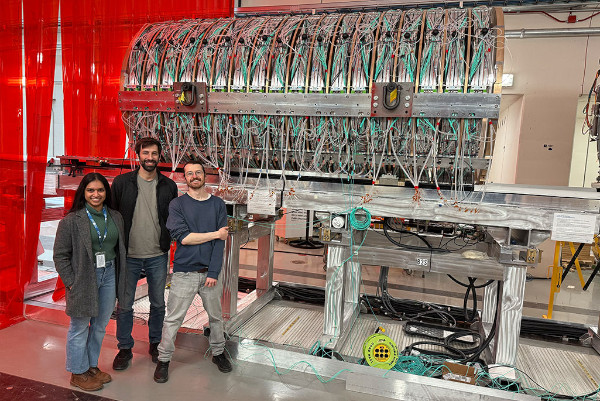
Berkeley Lab physicists have recently completed commissioning the Mu2e experiment’s straw tube tracker, a magnetic spectrometer that is exploring an extremely rare muon conversion process that holds great promise for the discovery of new physics.
The Mu2e “muon-to-electron-conversion” experiment at Fermilab will pioneer several novel experimental techniques – such as pulsed muon production and solenoidal beam transport – to search for the neutrinoless conversion of muons into electrons, and push the muon conversion discovery threshold several orders of magnitude beyond its current experimental limits.
Researchers in Berkeley Lab’s Physics Division have played key roles in the design and construction of the experiment, as well as testing the electronics, firmware, and software needed for the tracker to achieve its full potential. To make the targeted physics measurements, the Mu2e experiment consists of 2 primary detectors – the tracker and a cesium Iodide (CsI) crystal calorimeter, which are designed to measure properties of conversion electrons – and 3 secondary detectors.
The tracker was fully assembled in Summer 2025 and then delivered and installed in the Mu2e experiment at Fermilab late last year. Since its installation, Berkeley Lab’s Mu2e research team has been working onsite and in collaboration with Fermilab staff to prepare the tracker for operation, including the final construction of the low- and high-voltage distribution systems, routing the cables and fibers, and then connecting the tracker to its required services. The Berkeley Lab team has also been active in debugging and updating the firmware and software used to read out the tracker, and analyzing some of the first data being recorded.
As part of the April 2026 commissioning, the team completed their preliminary checks of the experiment’s electronics. The entire detector is now fully powered and integrated into operations. A full-scale commissioning of the high-voltage operation of the detector will continue into May.
Richie Bonventre, a staff scientist who currently leads the tracker firmware and software development, is working to expand the experiment’s scope and scale as more and more of the tracker comes online. Bonventre joined the Mu2e team twelve years ago as a Berkeley Lab Chamberlain Postdoctoral Fellow, then using ATLAS pixel detectors to precisely calibrate and characterize a small prototype of the Mu2e tracker. He has worked to develop these reconstruction and calibration algorithms, and finally had the opportunity to test them on real data from the tracker in the hall. “Fully reconstructing a track requires calibrating the timing of every straw as well as precisely synchronizing the timing between every electronics board to a fraction of a nanosecond,” said Bonventre. “Scaling up from small prototypes to synchronizing thousands of channels at this level required not just developing robust algorithms, but also more mundane tasks like double-checking the relative lengths of fiber optic cables.”
“It’s an exciting time to be ‘in the hall,’ both because bringing the tracker online is satisfying in itself, and because Mu2e’s other detectors are also making commissioning progress, and joint data-collection between multiple detectors is happening,” said Ed Callaghan, a Chamberlain Postdoctoral Fellow who has spent the past two years as one of two operations coordinators for the Mu2e tracker, responsible for electronics and software, in conjunction with a partner coordinator responsible for mechanics and fluids infrastructure. “As one of the software developers for the tracker, there’s been an interplay between those of us writing the monitoring software and those calibrating the on-board gas flow sensors, and that exchange of software development and fluid mechanics expertise is a foundational component to making the detector work, which many people don’t think about often.”
“It was particularly rewarding to see the fully assembled tracker being lowered into the experimental hall and to witness its transition from construction into commissioning and operations,” said Berkeley Lab postdoctoral fellow Namitha Chithirasreemadam, who joined Berkeley Lab’s Mu2e team in Fall 2025, just as the tracker was delivered. Chithirasreemadam is currently participating in the commissioning activities, supporting and coordinating day-to-day operations in the Mu2e hall at Fermilab under the guidance of the Mu2e operations coordinator. This experience has provided her with a systems-level perspective on the experiment, and as the tracker commissioning process progresses, she will turn more of her attention to calibration and simulation-tuning efforts for the tracker.
Given the scale of the tracker, with more than 20,000 individual sensors (or ‘straws’) distributed across 18 stations that are assembled to form the entire apparatus, many students and collaborators contributed to this effort. The Mu2e Collaboration currently comprises 239 members from over 40 institutions worldwide.
After the basic commissioning is done, Mu2e plans to record several months of cosmic ray data with the entire detector simultaneously. Researchers will use this data to calibrate and align the detector, and to refine and adapt the reconstruction algorithms and simulations to conform to actual detector data. The cosmic ray run will also be used to develop the procedures for routine detector operation. Mu2e’s first physics run using the Fermilab proton beam is planned in 2027. A multi-year run beginning in 2030 will determine the full physics discovery reach of the experiment.
—
Dave Brown, a senior scientist in the Physics Division, leads Berkeley Lab’s Mu2e research team.