
Berkeley Lab helps commission the Simons Observatory’s new telescopes
Berkeley Lab helps commission the Simons Observatory's new telescopes
Berkeley Lab and UC Berkeley are founding members of the Simons Observatory, and this current milestone is the culmination of many years of work on key aspects of the telescopes’ design and functionality
November 4, 2026 —
Berkeley Lab Physics Division News
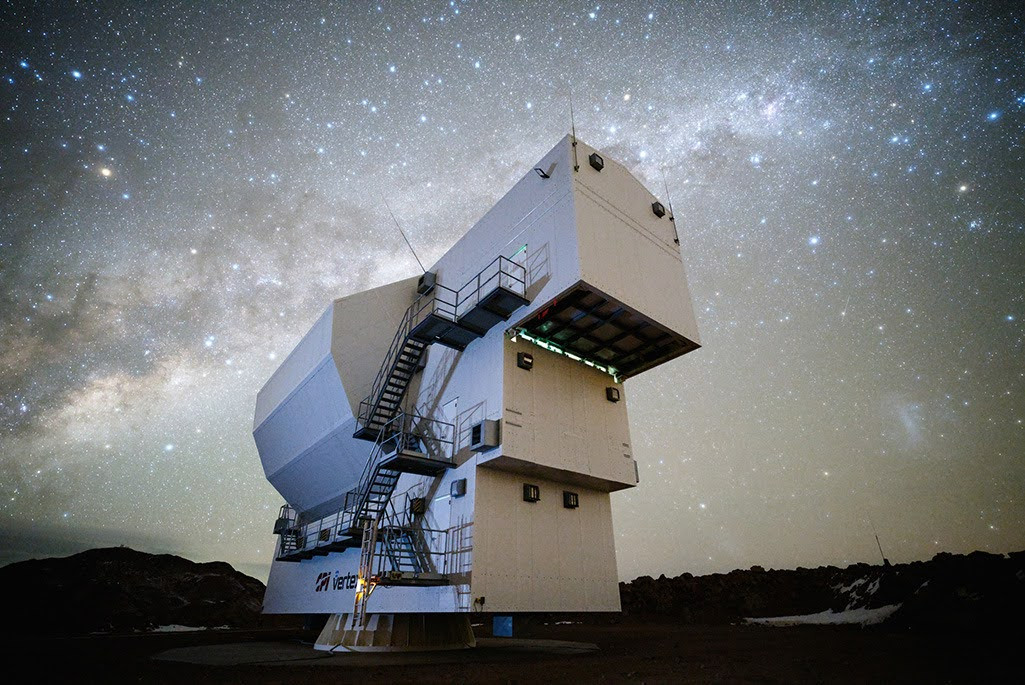
The Simons Observatory in Chile, which houses four telescopes – the Large Aperture Telescope (LAT) and three Small Aperture Telescopes (SATs) – is now completely online and conducting science operations. Together, these four telescopes look out on the cosmos with tens of thousands of detectors to collect the most precise measurements of the universe’s oldest light – the cosmic microwave background (CMB). These measurements could help astronomers understand how the cosmos was formed and provide a long-sought confirmation of the theory of cosmological inflation.
As founding members of the Simons Observatory (SO), Berkeley Lab and the University of California, Berkeley (UC Berkeley) continue to make key contributions to the telescope’s design and functionality, data management and software infrastructure, as well as to SO’s ongoing CMB science program.
“It’s wonderful to see the first science data coming out from Simons Observatory after nearly a decade of work from the whole team,” said Adrian T. Lee, professor of physics at UC Berkeley, senior faculty scientist in Berkeley Lab’s Physics Division, and a former spokesperson for the Simons Observatory. “The telescopes are now even more sensitive than they were designed to be. We can take as much data in just months as the previous generation of telescopes that we worked on could have taken in years. With this new capability, we’re sure to gain new insights into the birth of the universe and the nature of dark matter and dark energy – the big questions of cosmology today.”
Part of the Simons Observatory’s unique capabilities come from advances in instrumentation. The new observatory incorporates a total of 98,000 detectors that can map the sky several times faster than before, with the LAT alone scanning half the celestial sky every couple of days at much higher resolution than previous CMB telescopes.
The faster pace of observations has already allowed the LAT to produce the most comprehensive images of the Milky Way in polarized microwave light, and these types of images give scientists new information about magnetic fields in our galaxy, yielding new insights about star formation and galactic evolution. And as more data is collected, SO is planning to regularly release updated datasets, making them available to an even wider range of people in the astronomy community.
For nearly 20 years, Berkeley Lab’s Computational Cosmology Center (C3) has been leading efforts in large-scale simulation and analysis of data from CMB telescopes, enabling researchers to address cutting-edge computational problems in cosmology and hypothesize about the earliest moments of the Universe’s existence. Using their experience from previous CMB experiments as well all as work on the CMB-S4 Project, C3 researchers and computer scientists from the Lab’s Computing and Physical Sciences Areas now lead several aspects of SO’s data management efforts with a particular focus on simulations and software infrastructure.
“Large CMB computational challenges at the intersection of simulation and analysis are where C3 really shines,” says Ted Kisner, a computer systems engineer in Berkeley Lab’s Scientific Data Division and head of software infrastructure for the Simons Observatory. “We have a unique combination of experience and skills developed over decades of using high-performance computing resources to address the needs of the CMB community.”
While CMB experiments rely on extremely large and detailed simulations of the early universe, equally as important are extensive simulations of how these observations are made. The goal of the “simulated observing” of the sky is to model aspects of the telescope, the detectors, and the surrounding environment that might contaminate the measurements of light coming from the distant universe.
For instance, C3 researchers perform large simulations of how the SO telescopes observe the sky and how realistic instrument properties and environmental conditions could affect the final science results. “The SO site, located high in Chile’s Atacama Desert, is extremely dry, but we still have contamination due to atmospheric emission, absorption due to water vapor and oxygen, and scattering due to ice crystals,” explains C3 scientific engineering associate Shamik Ghosh, “and understanding these kinds of atmospheric contamination through modelling and simulation is important for removing it from our data.” The team is also heavily involved in modelling the emission of our own Galaxy, the Milky Way – which naturally emits radiation over the entire electromagnetic spectrum from radio waves to gamma rays – making it a key contaminant in CMB measurements.
Managing the massive volumes of data produced by these telescopes presents considerable challenges, so the Simons Observatory leverages the Department of Energy’s (DOE) National Energy Research Scientific Computing Center (NERSC) at Berkeley Lab for data transfer, backup, and analysis, and these computing capabilities form essential infrastructure for the SO project as well as the research collaboration. Over the lifetime of the observatory, Petabytes of raw data will be transferred from Chile to NERSC and then onwards to additional computing centers. “The storage and computational resources available at NERSC provide mission-critical support for extracting faint cosmological signals from the raw data,’ says Kisner, who manages NERSC resources allocated to multiple experiments across the CMB community.
Berkeley Lab’s Cosmology Group also continues to lead several crucial aspects of SO’s science program and currently co-leads SO’s CMB lensing cross-correlation effort, which will combine SO’s maps of the CMB with large-scale structure surveys such as the Dark Energy Spectroscopic Instrument (DESI) and the Rubin Observatory’s Legacy Survey of Space and Time (LSST) to test Einstein’s General Relativity on the largest scales.
“SO science is central to the Berkeley Lab Cosmology Group’s research, and it’s very exciting to see the first maps and preliminary results,” explains Simone Ferraro, a senior scientist in Berkeley Lab’s Physics Division who led one of SO’s inaugural science working groups that helped set the science and design requirements, and then co-led SO’s cross-correlation efforts. “The LAT will transform our view of the “dark” universe, mapping where the dark matter and gas are with unprecedented precision, searching for new particles, and looking for unique signatures of cosmic inflation.”
Future upgrades to the Simons Observatory are already under way, including the addition of three new SATs expected to be online in the coming year, funded by UK Research and Innovation (UKRI) and the Japan Society for the Promotion of Science (JSPS). With the recent installation of a new solar array and instrumentation that enhances the LAT’s sensitivity and doubles its mapping speed, which are being funded by the National Science Foundation (NSF), the observatory will be uniquely positioned to make groundbreaking measurements across the universe for years to come.
Learn more about the Simons Observatory’s telescope commissioning:
- Now Fully Online, Simons Observatory Begins Probe of Universe’s Birth
October 22, 2026 / Mara Johnson-Groh / Simons Observatory News - The Simons Observatory: Commissioning of the Mid-Frequency Small Aperture Telescopes
September 22, 2026 / Kathleen Harrington et al / arXiv