
Dark Matter’s Quantum Nature Leaves No Trace in Detectors
Dark Matter's Quantum Nature Leaves No Trace in Detectors
Scientists searching for dark matter increasingly use cutting-edge quantum technology to push the boundaries of what their instruments can detect. But what if dark matter itself had wild quantum mechanical properties? Would this impact what those modern detectors see?
April 29, 2026 — Marsha Fenner
Berkeley Lab Physics Division News
Scientists searching for dark matter increasingly use cutting-edge quantum technology to push the boundaries of what their instruments can detect. But what if dark matter itself had wild quantum mechanical properties? Would this impact what those modern detectors see?
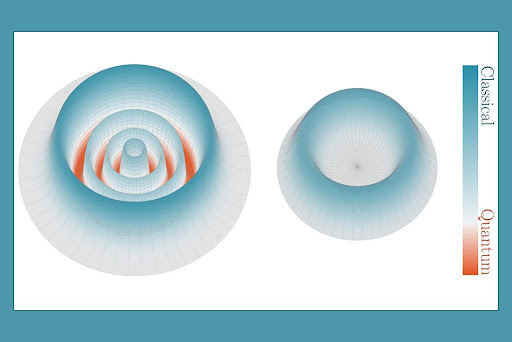
A recent study in Physical Review Letters, from physicists at Berkeley Lab, UC Berkeley, and the University of Chicago, investigated this possibility and found that while axion dark matter may exist in “a quantum state that has no complete classical description,” these effects provably vanish when viewed by a realistic detector.
“Dark matter makes up most of the matter in the universe, but it has never been directly detected,” explains Nick Rodd, a divisional fellow in Berkeley Lab's Physics Division Theory Group, who led the study. “One leading candidate is the axion, an extremely lightweight particle that would permeate space as a wave. In principle, that wave could be in an exotic quantum state, rather than behaving like an ordinary wave. This possibility has received a lot of attention in the community recently, as it might hint we’re not thinking about axion detection correctly.”
Using quantum optics techniques, the research team developed a fully quantum model of axion detection and showed that the effects of axion dark matter – and those of other ultralight wave-based dark-matter candidates – can be exactly reproduced with classical waves. The study also presents a general method to compute the effects of exotic dark-matter states, as well as results relevant for the gravitational wave and quantum optics communities, who may appreciate seeing their techniques applied in a very different context.
“This new study simplifies the theoretical basis for the entire field of ultralight dark matter,” says Rodd. “Although the founding principle of the field – that the axion can be treated classically – is correct, this new study places these foundations on firm ground for the first time.”
Learn more:
Intrinsically Quantum Effects of Axion Dark Matter are Undetectable
April 29, 2026 / Physical Review Letters
Authors: Yunjia Bao, Dhong Yeon Cheong, Nicholas L. Rodd, Joey Takach, Lian-Tao Wang, Kevin Zhou