
Dario Gil and Kathy Yelick visit DESI at Kitt Peak
Dario Gil and Kathy Yelick visit DESI at Kitt Peak
November 11, 2026 — Marsha Fenner
Berkeley Lab Physics Division News
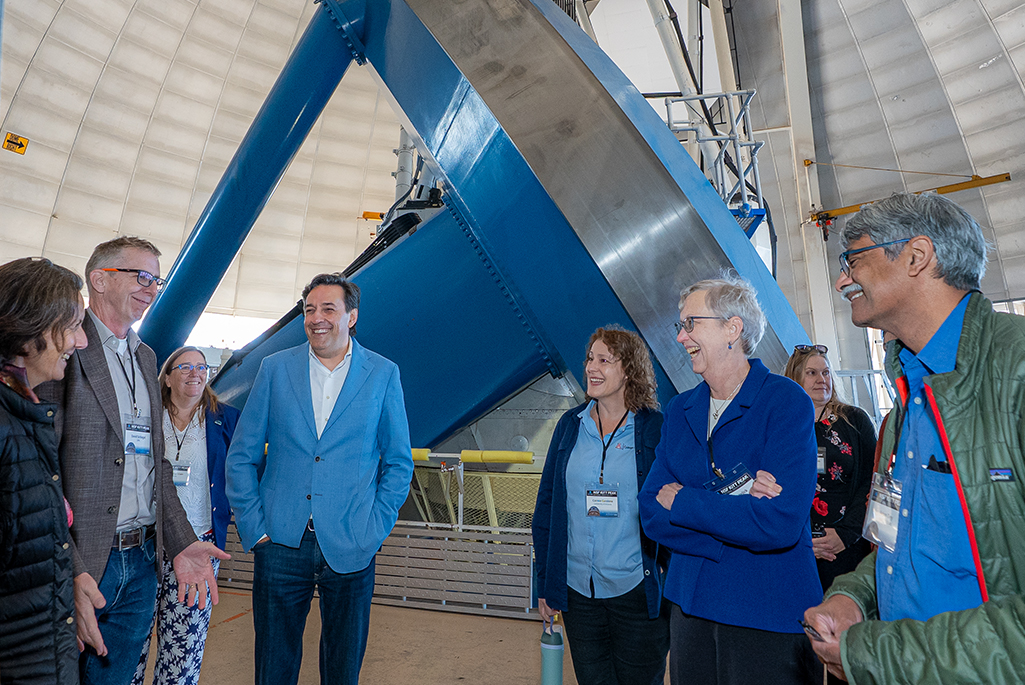
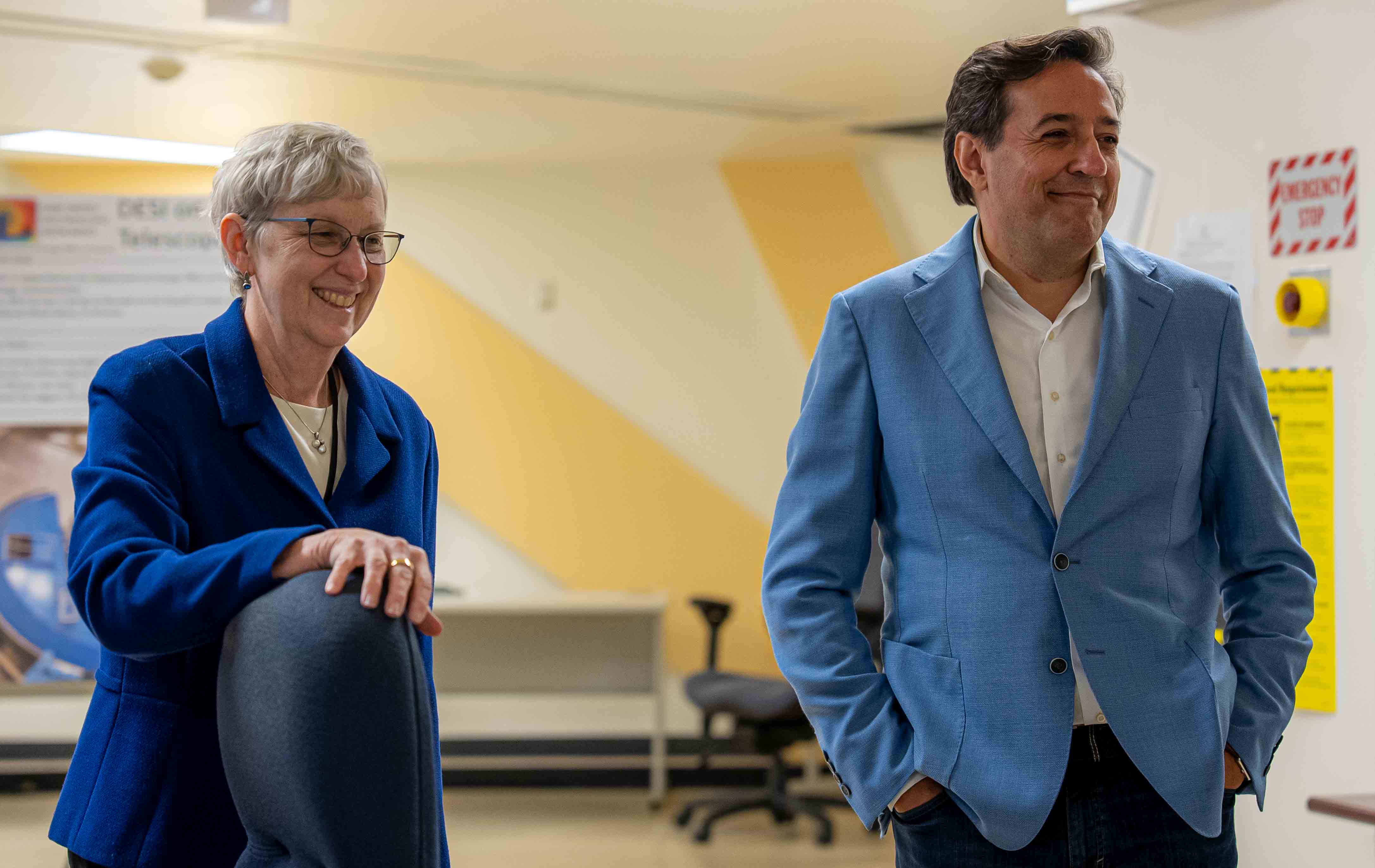
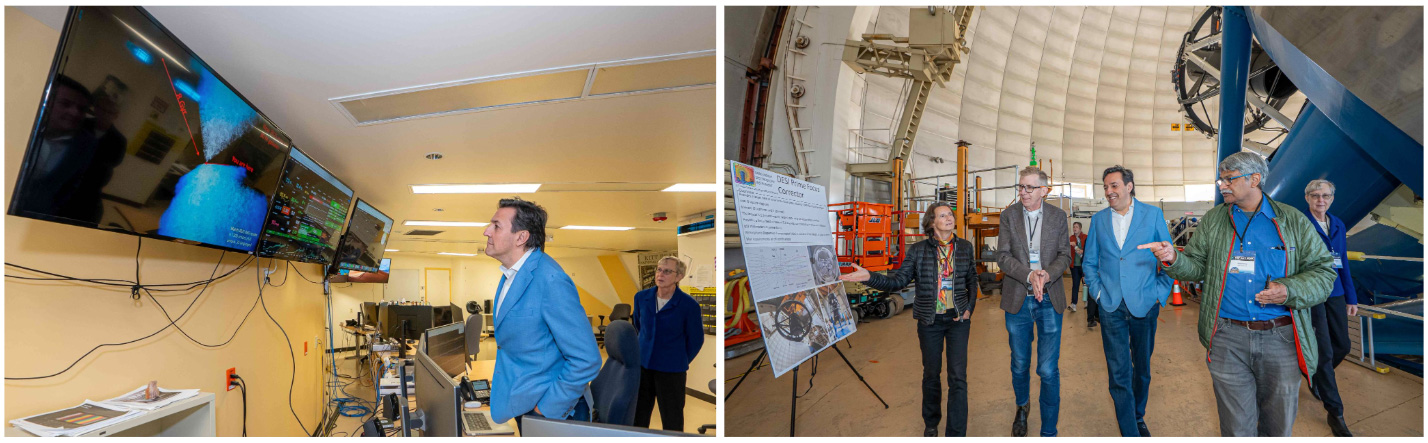
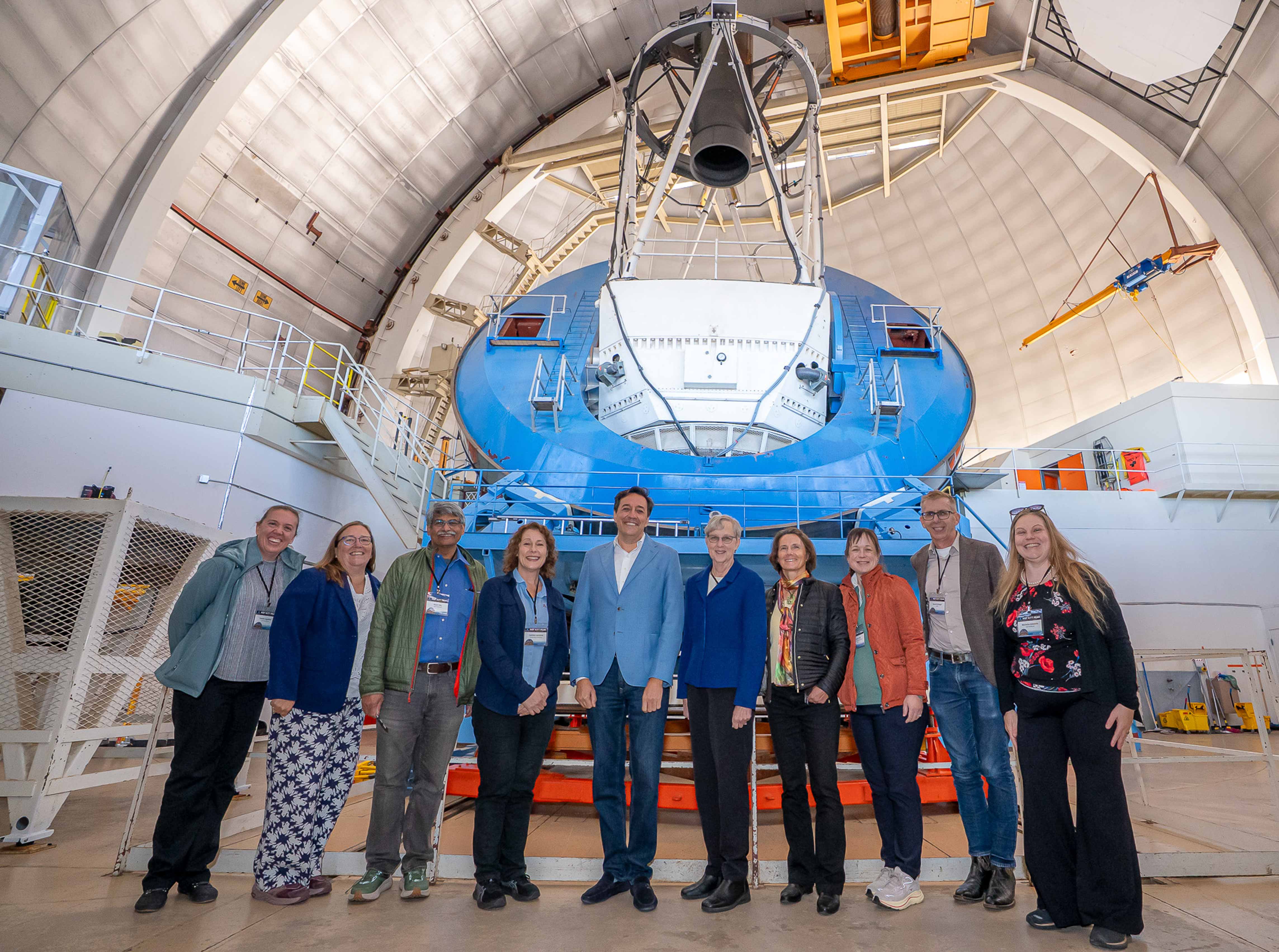
DOE Under Secretary for Science Dario Gil and Berkeley Lab Director Kathy Yelick visited DESI at Kitt Peak in Arizona on November 2.
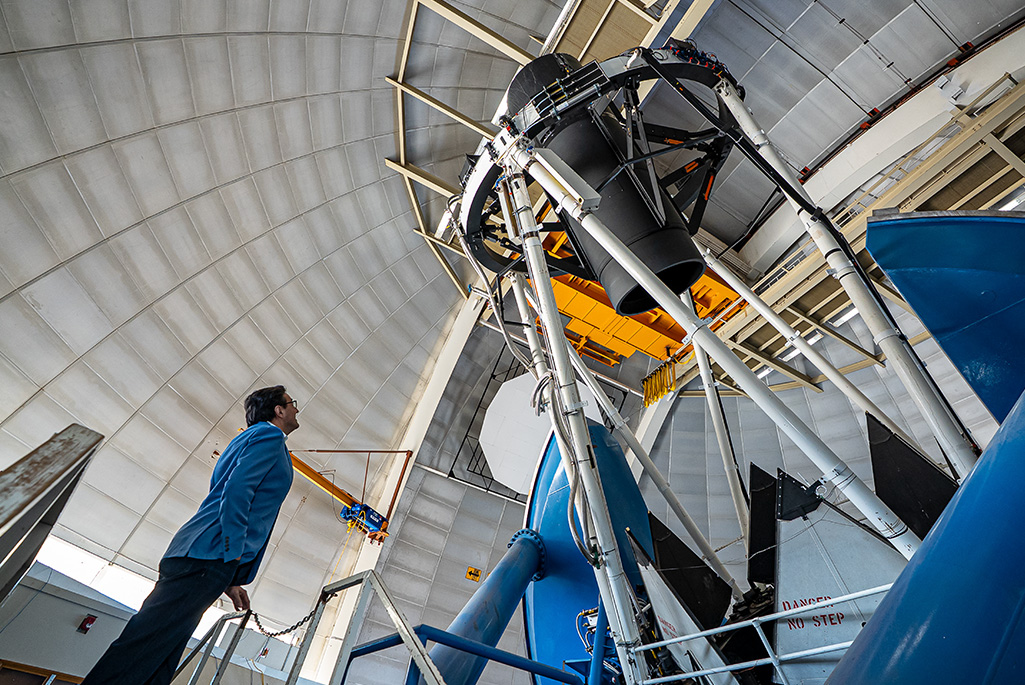
On November 2, DOE Under Secretary for Science Dario Gil visited the Kitt Peak National Observatory in Arizona, home of the Mayall 4-meter Telescope, which currently hosts the Dark Energy Spectroscopic Instrument (DESI), an international, Berkeley Lab-led experiment that has produced the largest 3D map of the universe to date. Researchers use the map to explore dark energy, which makes up about 70% of our universe and drives its accelerating expansion.
Berkeley Lab Physics Division Director Nathalie Palanque-Delabrouille and DESI Senior Scientist David Schlegel were joined by new Lab Director Kathy Yelick, on her first visit to Kitt Peak.
“It was a great pleasure to introduce DESI and its groundbreaking science to Dario Gil,” said Palanque-Delabrouille. “The visit offered a unique opportunity to showcase the Lab’s ability to manage a complex project from initial construction through to successful operations.”
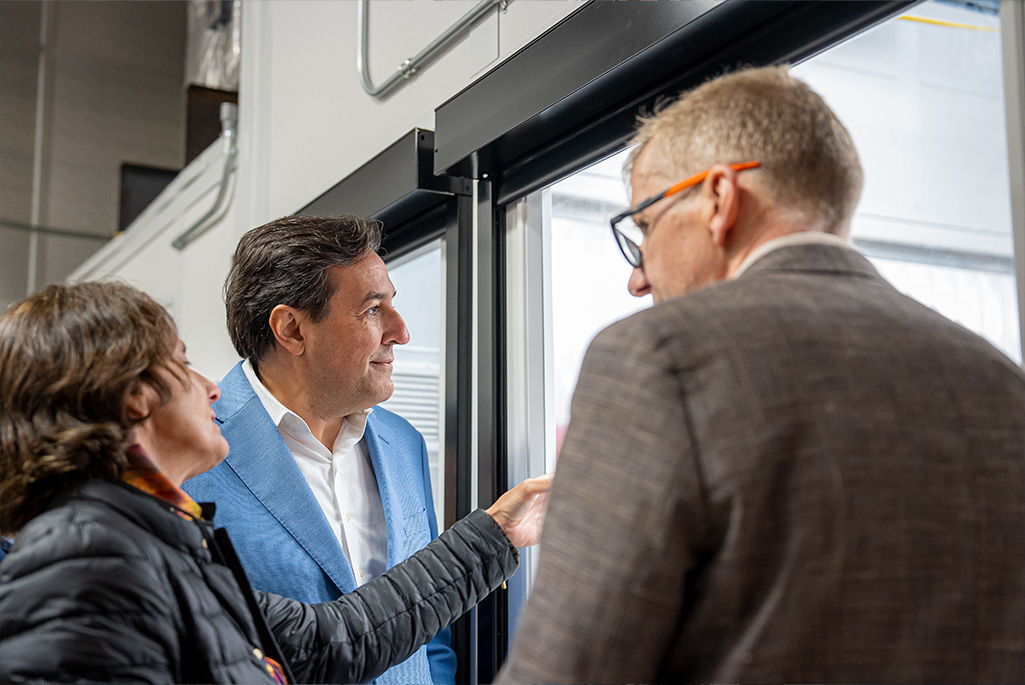
The highlight of the tour was the experimental instrument itself, which uses 5,000 robotic positioners that precisely align optical fibers with the location where the light from distant galaxies reaches the focal plane, to an accuracy within 10 microns (or less than the width of a human hair). This novel approach has enabled DESI to map the universe much faster than all prior surveys. Topics of discussion included the role of artificial intelligence (AI) in data analysis and how DESI is developing innovative AI-driven approaches at all stages of the DESI data lifecycle.
“The DESI spectrographs give us the data to place each galaxy on a three-dimensional map,” said David Schlegel, Senior Scientist in Berkeley Lab’s Physics Division. “Our maps are now so large that simulating universes with enough volume and fidelity to interpret them has been one of our biggest challenges. AI-enabled approaches will let us do that.”
Concluding the tour, Palanque-Delabrouille and Schlegel presented some of the ways DESI is moving into the future, including the DESI Run 2 survey currently in development, and proposals for what a next-generation instrument could look like.
“DESI continues to map the universe at an incredible pace. In a good month, we measure as many spectra of distant galaxies as all prior surveys over two decades,” continued Palanque-Delabrouille. “ It was a privilege to discuss the intriguing insights we are uncovering about dark energy through this unprecedented 3D cosmological map.”
To close the day’s visit, the group enjoyed observations of the sunset using Kitt Peak’s McMath-Pierce Solar Telescope, the world’s largest solar telescope, followed by observations of Neptune, Saturn, and various nebulae and globular clusters at the 0.6-meter Shreve Telescope.
DESI is supported by the DOE Office of Science and by the National Energy Research Scientific Computing Center, a DOE Office of Science national user facility. Additional support for DESI is provided by the U.S. National Science Foundation; the Science and Technology Facilities Council of the United Kingdom; the Gordon and Betty Moore Foundation; the Heising-Simons Foundation; the French Alternative Energies and Atomic Energy Commission (CEA); the National Council of Humanities, Sciences, and Technologies of Mexico; the Ministry of Science and Innovation of Spain; and by the DESI member institutions.
The DESI collaboration is honored to be permitted to conduct scientific research on I’oligam Du’ag (Kitt Peak), a mountain with particular significance to the Tohono O’odham Nation.