QIS For HEP
Quantum Sensors for Dark Matter Detection
Superconducting Sensors
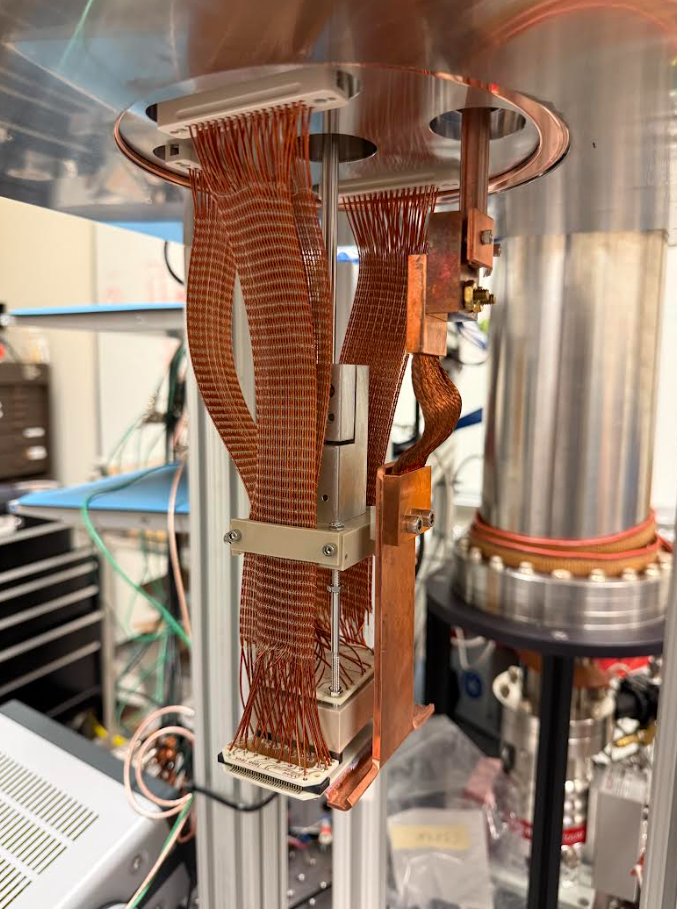
Our Superconducting quantum sensor work focuses on understanding and pushing the limits of phonon energy resolution. This includes investigating the origin of the Low Energy Excess (LEE) background in superconducting devices, from transition edge sensors to qubits. We collaborate with LBNL and UC Berkeley materials scientists to understand he connections between materials and processing and performance. Examples of this work can be found at phononics.lbl.gov. We also collaborate closely with the TESSERACT collaboration for device testing and LEE characterization (see for example https://doi.org/10.1063/5.0247343)
we have developed a process for low Tc kinetic microwave inductance detectors (MKID) using hafnium (arXiv:2502.19818). This was a necessary step towards the development of quasiparticle trapping MKIDs, which would enable RF readout of future dark matter search experiments. We are also applying this to Josephson Johnson (JJ) devices, such as SQUATs using JJ fabrication at foundry.lbl.gov

Optomechanical Sensors
Our program has given rise to two new experiments exploiting optomechanical quantum measurement:
- Use of levitated superconducting devices to search for gravitational waves, in particular those with frequencies in the 10 kHz-10 MHz range, which is above LIGO’s detection band (arXiv:2408.01583)
- Quantum Invisible Particle Sensor (QuIPS), in collaboration with Yale U., uses optically levitated nanospheres, loaded with beta emitters, together with conventional electron particle detectors to fully reconstruct the 4 momentum of emitted invisible particles, such as (sterile) neutrinos ((PRX Quantum 4 (2023) 1, 010315). We aim to use squeezed light to make boost the sensitivity (arXiv:2502.05168). In addition to the quantum techniques for measuring levitated particle recoil, this project involves challenges of low momentum electron track reconstruction and loading nanoparticles with radioactive isotopes.
At a more theoretical level, we produced important results related to experimental tests
of quantum gravity. One, arXiv: 2409.03894, settled a long-standing debate about the size of vacuum fluctuations in the gravitational field and their effect on a gravitational wave detector. The other, arXiv:2502.17575, proposes a concrete model of Verlinde’s “entropic gravity” and a number of experimental tests. This work strongly motivated a Heising-Simons funded experiment with UC Berkeley, which looks for anomalous noise in the gravitational interaction.